
Views: 222 Author: Amanda Publish Time: 2025-11-09 Origin: Site


Content Menu
● What makes a turning lathe high precision?
● Core design features that drive precision
● Operational workflows that maximize precision
● Automation, connectivity, and Industry 4.0
● 5-axis turning: extending precision and efficiency
● Metrology and quality assurance
● Choosing a turning lathe for high-precision work
● Shangchen: an OEM partner for rapid prototyping and precision turning
● Embedding turning activities in a broader manufacturing ecosystem
● Practical tips for brand owners and distributors
● FAQ
>> 1. How does thermal stability affect precision turning?
>> 2. What role do on-machine probes play in quality control?
>> 3. How can 5-axis capabilities improve component precision?
>> 4. What are key considerations when selecting a turning lathe for high-volume production?
>> 5. How does automation integration influence throughput and consistency?
In today's global manufacturing landscape, high-precision turning lathes are indispensable for turning raw stock into exacting, repeatable components. For brands, distributors, and contract manufacturers partnering with OEM suppliers, the ability to deliver consistent, high-quality parts on time is a competitive differentiator. This article delves into the design philosophies, control architectures, process strategies, and ecosystem factors that distinguish a high-precision turning lathe, with particular emphasis on how Shangchen's integrated capabilities—ranging from rapid prototyping to precision turning, sheet metal fabrication, 3D printing, and mold production—support end-to-end OEM requirements.
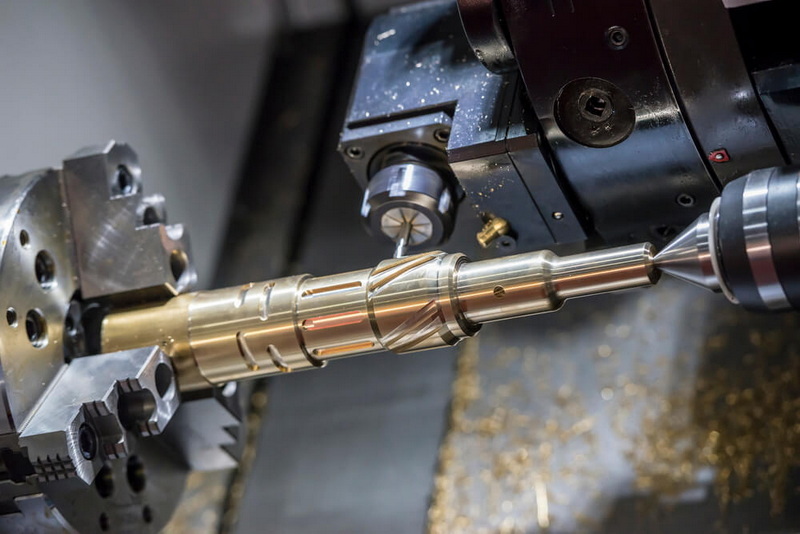
- Tight tolerances and finish: Achieving tight dimensional tolerances and smooth surface finishes demands rigid machine architecture, stable thermal behavior, and refined spindle and tooling systems. Consistency in tolerance control is especially critical for high-volume runs where minor deviations compound across thousands of parts.
- Reproducibility and stability: Precision turning hinges on repeatability across batches. Closed-loop feedback with high-resolution encoders, stable servo control, and robust calibration routines keep part-to-part variation within specification.
- Dimensional stability under load: Deflection, vibration, and thermal growth can erode precision. Modern high-precision turning lathes incorporate thermally stable castings, active cooling, and strategic enclosure design to minimize drift.
- Adaptability to diverse parts: The best machines accommodate a variety of materials and geometries, from simple shafts to complex profiles, often through multi-axis or live-tooling configurations that reduce setups and human-induced errors.
- On-machine metrology and automation: Integrated probing, spindle tachometers, and real-time condition monitoring empower operators to verify features mid-process and adjust parameters proactively.
- Process-control maturity: Advanced CNC controls with high-speed interpolation, look-ahead, and adaptive offset management enable smoother tool paths, better surface integrity, and reduced scrap.
- Tooling and spindle performance: Rigid tool holders, balanced spindles, and optimized tool paths minimize runout and chatter, which translates directly into better concentricity and surface finish.
- Material handling and chip control: Efficient swarf management and chip evacuation reduce heat buildup and re-cutting, preserving dimensional accuracy and extending tool life.
- Stiff bed and column assembly: A robust, vibration-damping foundation minimizes deflection under cutting forces, ensuring stable geometry across long cycles.
- Precision spindle system: High-quality bearings, accurate runout control, and balanced rotors support accurate starts and finishes, particularly for fine features and close tolerances.
- Backlash-free linear guidance: Ball-screw driven axes with high stiffness and careful nut indexing deliver repeatable positioning and accurate contouring.
- Thermally aware architecture: Materials selection, enclosure design, and active cooling mitigate thermal expansion effects that otherwise blur tolerances during lengthy production runs.
- Multi-axis and live tooling readiness: When off-axis features or complex geometries are required, integrated 4- or 5-axis capability with live tooling reduces handling and improves alignment between features.
- Probing and automation support: On-board probing, palletized workholding, and compatibility with robotics or automated loaders shorten setup times and improve uptime.
- Chip management: Proper chip flow paths, filtration, and evacuation kinematics help maintain clean work areas and stable cutting conditions.
- Rigorous setup discipline: Secure fixturing, precise workholding, and verified workpiece alignment minimize surprises during the first-cut pass.
- Parameter optimization: Careful balancing of cutting speed, feed, and depth of cut reduces thermal spikes, tool wear, and residual stress while achieving desired surface quality.
- Progressive finishing strategy: Layered finishing passes with diminishing depths of cut yield smoother surfaces and tighter tolerances without overtaxing tools.
- Probing-driven offsets: Automated measurement and compensation ensure consistent tolerances across multiple parts, even when initial workpieces vary slightly.
- Real-time monitoring and adaptive control: Tracking spindle load, temperature, vibration, and lubrication status allows timely adjustments to protect quality metrics.
- Quality-centric data capture: Recording process parameters, measurements, and inspection results enables traceability and continuous improvement via SPC (statistical process control).
- Metals: Aluminum, stainless steel, carbon steel, and exotic alloys each present unique cutting challenges. High-precision turning leverages optimized tool geometry, coating selections, and coolant strategies to maintain dimensional fidelity and surface integrity.
- Hard-to-machine alloys: Heat-treated or high-temp alloys require careful coolant management, tool materials, and sometimes vibration damping strategies to minimize thermal distortion.
- Plastics and composites: Thermoplastics and composite materials demand controlled temperature profiles to prevent surface marring or internal crystallization while achieving consistent tolerances.
- Complex geometries: Parts with tight radii, deep pockets, or threaded features benefit from live tooling, high-precision guides, and precise spindle indexing.

- On-machine metrology: Integrated measurement systems support early defect detection and first-article verification, speeding up acceptance cycles.
- Tool condition monitoring: Predictive maintenance for tools reduces unexpected wear-related variation, maintaining stable process outputs.
- Data-driven optimization: Continuous data collection across machines and shifts supports ongoing refinements in cutting data, tool paths, and maintenance schedules.
- Shop-floor integration: Seamless data exchange with MES/ERP systems improves scheduling, traceability, and performance dashboards for brand owners and distributors.
- Single-setup capabilities: 5-axis turning allows the creation of complex features in a single setup, reducing part handling and misalignment risks.
- Improved geometry accuracy: Simultaneous multi-axis motion can closely follow complex profiles, resulting in better tolerance control and surface finish.
- Path efficiency: Optimized tool paths and reduced repositioning lower cycle times, contributing to consistent throughput in high-mix, low-volume production or higher-volume runs.
- In-process verification: On-machine measurement reduces reliance on downstream QA steps and accelerates feedback loops.
- Final inspection: Coordinate Measuring Machines (CMM) and surface testers verify conformance against customer specifications, with traceable data management.
- Documentation and traceability: Clear process documentation and inspection records support auditable quality systems and regulatory compliance.
- Structural rigidity and thermal control: Prioritize machines proven to maintain geometry under load and across temperature variations.
- Spindle quality and control maturity: Evaluate runout, torque across speed ranges, and the robustness of control software for complex part features.
- Retrofit paths and scalability: Consider future-proofing with upgrade options for 5-axis expansion or automation integration.
- After-sales and training: Strong vendor support, readily available spare parts, and practical operator training are essential for sustained precision in production environments.
- Integrated capabilities: Shangchen's portfolio spans rapid prototyping, CNC machining, sheet metal work, 3D printing, molds, and production-grade precision turning, enabling true end-to-end solutions for brand owners and manufacturers.
- Customization and private labeling: Flexible process customization and branding support help partners differentiate their products in competitive markets.
- Global collaboration and reliability: A global mindset and robust supply chain ensure consistent quality and dependable delivery schedules, even for complex projects.
- Quality-first approach: A dedicated emphasis on repeatability, process control, and validated outcomes aligns with OEM-level requirements for scale and batch-to-batch consistency.
- Prototype-to-production continuity: Ensuring geometry fidelity, tooling stability, and repeatable processes from early prototypes through full-scale production reduces risk and lead times.
- Multi-process integration advantage: Coordinating turning with additive manufacturing, sheet metal, and post-processing capabilities shortens cycle times and expands design latitude.
- Value-added services alignment: Deburring, coating, anodizing, and heat treatment can be scheduled alongside turning operations to optimize cost, timelines, and quality.
- Clear specifications: Provide precise tolerances, surface finishes, critical dimensions, and inspection criteria to enable accurate quoting and process planning.
- Early validation programs: Small-scale pilot runs or first-article inspections help verify feasibility before committing to large production volumes.
- Supply-chain resilience: Discuss lead times, material availability, and contingency planning to mitigate disruption risks.
- Post-processing alignment: Align finishing, coating, or assembly steps with machining to ensure seamless downstream workflows and quality control.
A high-precision turning lathe stands out not merely by its mechanical rigidity or spindle torque, but by the entire ecosystem surrounding it: thermal stability, control maturity, measurement integration, automation readiness, and a partner's capability to deliver end-to-end OEM solutions. When integrated with a broad manufacturing platform like Shangchen, which combines prototyping, precision turning, sheet metal, 3D printing, and mold production under one roof, the result is a scalable, reliable pathway from concept to high-volume production. This synthesis of machine capability, process discipline, and supply-chain coordination enables brands, wholesalers, and manufacturers to meet stringent specifications, accelerate time-to-market, and achieve repeatable quality across diverse product families.
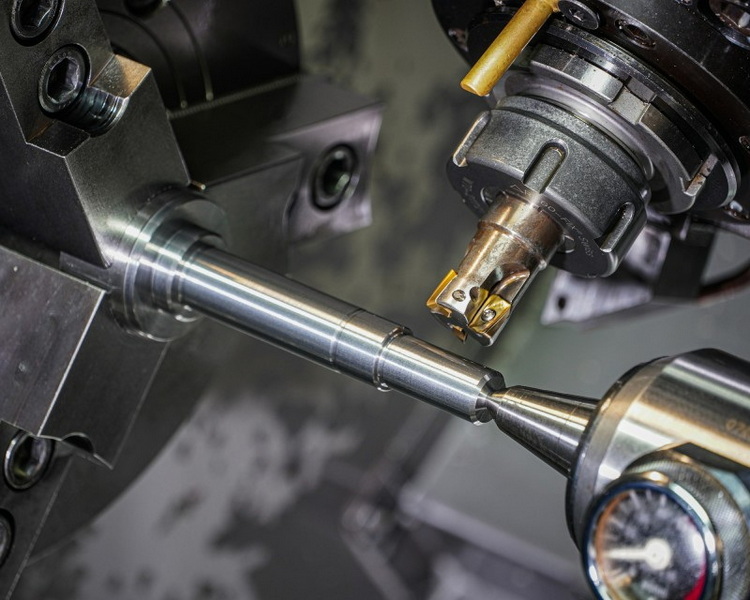
Thermal stability minimizes dimensional drift during machining, preserving tolerances and surface quality across production hours.[1][2]
Probes enable first-article verification and mid-process adjustments, reducing scrap and ensuring consistent part geometry.[4][6]
5-axis turning enables complex geometries in a single setup, improving concentricity, reducing handling errors, and shortening cycle times.[5][8]
Prioritize rigidity, thermal management, spindle quality, control maturity, scalability, and after-sales support.[3][9]
Automation, probing, and data connectivity align production with modern MES/ERP workflows, boosting uptime, traceability, and process optimization.[6][10]
[1](https://www.taikanmachine.com/products/l-25m-high-precision-cnc-horizontal-turning-milling-lathe/)
[2](https://www.directindustry.com/industrial-manufacturer/high-precision-lathe-161897.html)
[3](https://maxnovopower.en.made-in-china.com/product/sSpEnkfKANWj/China-High-Precision-D560X3000-Horizontal-Metal-Turning-Engine-Lathe-Machine.html)
[4](https://bfweurope.com/products/vertical-lathes/ivl-250/)
[5](https://machine-tools.victortaichung.com/shop/category/cnc-turning-lathes-6)
[6](https://www.accio.com/plp/precision-turning-lathe-machining)
[7](https://cncwmt.com/latest-news/what-are-the-specifications-of-lathe-machine/)
[8](https://www.jesco.com.tw/general-lathe-series.html)
[9](https://haksancnc.com.tr/en/product-detail-sl-8cnclathe-1598)
[10](https://headland.au/static/e5242825ceb226b61081f683c436db4a/BOST-Catalogue.pdf)

