
Views: 222 Author: Amanda Publish Time: 2025-11-10 Origin: Site


Content Menu
● Core Principles: How Turning Lathe Works Versus Milling
>> Milling machine fundamentals
● Geometric Capabilities and Part Types
● Materials, Finishes, and Tolerancing
>> Surface finish considerations
● Process Integration: Cost, Setup, and Throughput
>> Setup complexity and changeovers
>> Tooling considerations and lifecycle
● Hybrid and Single-Setup Strategies
>> Turn-mill and live tooling versatility
>> Design strategies for OEM collaboration
● Design-for-Manufacturing (DFM) Guidance for OEM Partners
>> Geometry and feature planning
>> Tolerances and verification
>> Material and supply chain alignment
● Real-World Scenarios and Practical Examples
>> Scenario A: Prototyping a metal shaft guide with a threaded tip
>> Scenario B: Aluminum component with pockets, slots, and through-holes
>> Scenario C: High-volume production of small, tight-tolerance components
● OEM Outsourcing Considerations for International Partners
>> Vendor vetting and collaboration
>> Value proposition for Shangchen
● FAQ
>> 1. What is turning lathe best used for, and when should milling be preferred?
>> 2. How does a live-tooling turn-mill differ from a dedicated milling or turning center?
>> 3. Can CNC turning and milling be performed in a single setup for the same part?
>> 4. What quality checks are typical after turning and milling operations?
>> 5. How do material choices affect the decision between turning and milling?
In the landscape of modern manufacturing, choosing between turning lathe operations and milling machine operations is a decision that shapes design feasibility, production throughput, surface quality, and total cost of ownership. For Shangchen, a Chinese rapid prototyping and OEM service provider, the ability to articulate the strengths and limits of turning lathe processes alongside milling processes helps foreign brand owners, wholesalers, and manufacturers align product design with feasible, efficient, and scalable production plans. This article presents a thorough comparison of core capabilities, geometry handling, tooling considerations, process reliability, and practical design-for-manufacturing guidance. It is crafted to support informed decision-making across prototypes, small-batch runs, and high-volume production, while keeping a clear eye on the OEM workflow that integrates turning lathe and milling operations to satisfy diverse customer requirements.

- In turning operations, the workpiece is mounted on a spindle and rotated, while a fixed or traversing single-point cutting tool removes material along the axis of rotation. The result is predominantly cylindrical or coaxial features with exceptional concentricity when properly fixtured.
- Common turning tasks include facing, external turning to establish precise diameters, boring to create internal bores, threading both external and internal, grooving, knurling, and parting. These operations leverage continuous material removal along the length of the rotating workpiece.
- For components with long, uniform cross-sections, turning lathe setups typically offer rapid cycle times, predictable tool wear, and repeatable diameters, which translate into high-volume efficiency and tight runout control.
- Milling machines remove material with rotating cutting tools while the workpiece remains fixed or moves in multiple axes. This enables a broader spectrum of geometries, including flats, pockets, slots, complex contours, and multi-surface features.
- Modern milling centers—especially multi-axis and five-axis variants—facilitate high-precision contouring, advanced surface finishes, and intricate features that go beyond cylindrical symmetry.
- Milling excels at creating planar features, complex pockets, axial and radial features, and non-round geometries, making it indispensable for many finished parts and assemblies.
- Optimal for bar stock and cylindrical billets, where concentricity and tight diametral tolerances are paramount.
- Ideal for components such as shafts, bushings, sleeves, and collars where the primary geometry is rotationally symmetric.
- Internal bores and threads can be produced with high precision when the geometry aligns with turning operations.
- Superior for non-cylindrical parts, flat surfaces, pockets, slots, and complex contours.
- Enables precise features across multiple planes and orientations, including complex fillets, bevels, and sculpted surfaces.
- Five-axis milling expands capabilities for intricate geometries and highly finished surfaces, often reducing the need for secondary operations.
- Both turning and milling handle a broad range of metals (steel, aluminum, titanium, copper alloys) and engineering plastics. The choice often hinges on geometry, required tolerances, and downstream finishing steps.
- Composite materials and exotic alloys may require specialized tooling and strategies to achieve consistent results, regardless of whether turning or milling is employed.
- Turning provides excellent roundness and cylindricity, especially when the setup minimizes runout and tool wear is managed through proper cutting conditions.
- Milling delivers flatness, surface texture control, and complex surface finishes through strategic toolpath planning, coolant strategies, and multi-axis interpolation.
- Turning-centric designs typically emphasize coaxiality, concentricity, and diameter tolerances; milling-centric designs emphasize flatness, perpendicularity, and positional tolerances across multi-planar features.
- Integrated QA processes, including CMM-based verification and surface roughness measurements, should be planned into the manufacturing workflow to ensure conformance across turns and milled features.
- For cylindrical parts, turning lathe setups tend to be faster with shorter changeover times between diameters and threadings, contributing to lower unit costs in high-volume runs.
- Milling requires robust fixturing, probing, and tooling strategies to accommodate diverse features, which can increase upfront setup effort but pay off in feature-rich parts.
- Turning tooling focuses on external and internal turning, boring, and threading; lifecycles are sensitive to workpiece hardness and cutting parameters.
- Milling tooling covers a wider range of cutting actions: end mills, ball mills, thread mills, and slot drills, with lifecycle dependent on material hardness, chip load, and coolant effectiveness.
- For parts dominated by cylindrical features, turning intensifies throughput with high repeatability and low defect rates in high-volume production.
- For parts requiring multiple faces and complex geometries, milling centers—and in some cases, mill-turn configurations—can consolidate processes, potentially shortening lead times and reducing handling.
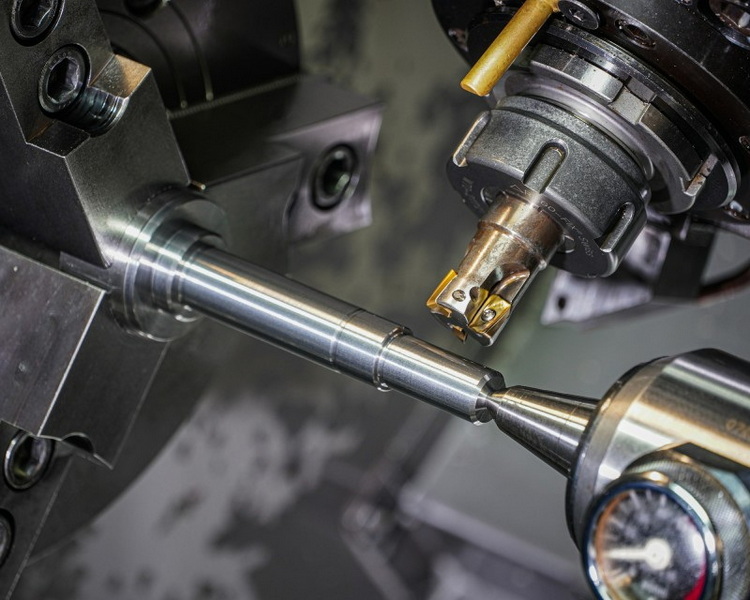
- Modern turn-mill centers combine turning and milling in one setup, enabling milling operations to be performed on the same machine that performs turning. This reduces part handling, improves concentricity, and speeds up production for hybrid geometries.
- Live tooling expands the capability of turning centers to address features that would otherwise require a separate milling operation, delivering cost savings and tighter tolerances in a single workflow.
- When primary features are cylindrical, plan for turning as the backbone with targeted milling as secondary operations to complete holes, pockets, and flats.
- For parts with flat surfaces, pockets, and complex contours, design for multi-axis milling while leveraging secondary turning for precise cylindrical sections when needed.
- Consider modular designs that enable efficient turning-first or milling-first workflows, enabling faster debug cycles during prototyping and smoother scale-up for production.

- Favor cylindrical symmetry where concentric tolerances are critical; otherwise, plan for milling to achieve precise planes and multi-surface relationships.
- Minimize undercuts and avoid geometries that necessitate excessive setups or handoff between machines.
- Align tolerances with the most reliable process in the sequence; ensure that both diametral and flatness tolerances are specified in a way that matches the capabilities of the chosen machine tools.
- Plan for post-process inspection steps, including CMM checks, surface finish characterization, and material traceability, to ensure manufacturing confidence on first articles and during production.
- Validate the availability of base materials, coatings, and heat treatments at the supplier level to minimize lead times and ensure consistency.
- Build staggered production plans with clear quality gates to prevent bottlenecks during scale-up and guarantee repeatability across lots.
- Approach: Use turning to establish the primary cylindrical geometry and internal bore, followed by targeted milling to form a profiled tip, end cap features, and any threading reliefs. A turn-mill approach could execute these in a single sequence for efficiency.
- Approach: Primary milling to define pockets and faces, with secondary turning operations for cylindrical features or through-holes. Live tooling in a turn-mill configuration can minimize handling and streamline the workflow.
- Approach: A dedicated turning line for cylindrical sections, coupled with automated milling for finishing surfaces and precise features. The emphasis is on process control, stable tooling, and robust inspection routines to sustain quality across audits.
- Demand transparency on capabilities, material sourcing, process validation, and tolerancing ranges. Request pilot runs to validate form, fit, and finish before committing to larger orders.
- Seek a partner who can deliver end-to-end services—from design for manufacturing (DFM) input to post-processing, heat treatment, and surface finishing, ensuring seamless integration into the customer's supply chain.
- With a balanced capability set that includes turning lathe, milling, live tooling, sheet metal, 3D printing, and mold production, Shangchen can tailor integrated workflows that reduce lead times, minimize defects, and ensure consistent quality for complex components across international markets.
Turning lathe operations and milling operations each offer distinct advantages, and the most effective OEM strategy often blends both approaches to exploit their complementary strengths. The decision framework hinges on part geometry, required tolerances, desired surface finish, production volume, and total lead time. For international brands and wholesalers seeking a robust, end-to-end partner, Shangchen's integrated capabilities enable optimized sequencing, reduced handling, and consistent quality across prototypes and scalable production. By mapping design intent to the most suitable manufacturing pathway and embracing a turn-mill-enabled hybrid workflow when needed, a reliable, cost-effective, and responsive supply chain emerges that satisfies diverse customer requirements and production scales.
Answer: Turning lathe processes excel at cylindrical and axisymmetric features where concentricity is critical; milling is preferred for flat surfaces, pockets, and complex contours.[11][12]
Answer: A live-tooling turn-mill combines turning and milling in one setup, enabling feature-rich parts with reduced handling and potentially tighter tolerances.[12][11]
Answer: Yes, on turn-mill or mill-turn platforms, enabling efficient integration of cylindrical and multi-surface features in one clamping.[11][12]
Answer: Typical checks include dimensional verification (diameter, runout, flatness), surface finish measurements, and material certification verification via CMM or inspection reports.[12][11]
Answer: Material properties influence chip formation, tool wear, and surface finish strategies; certain materials may be better suited to turning for cylindrical parts, while others may benefit from milling for precise planar features.[1][13]
[1](https://cncwmt.com/qa/lathe-vs-milling-machine-whats-the-difference/)
[2](https://www.longshengmfg.com/which-is-better-a-lathe-or-a-milling-machine/)
[3](https://www.3erp.com/blog/turning-vs-milling/)
[4](https://rosnokmachine.com/lathe-vs-mill/)
[5](https://www.mastercam.com/news/blog/milling-turning-and-mill-turn-what-are-the-differencesmilling-turning-and-mill-turn-what-are-the-differences/)
[6](https://www.americanrotary.com/blog/milling-vs-lathe/)
[7](https://phillipscorp.com/india/difference-between-cnc-latheand-cnc-milling/)
[8](https://www.youtube.com/watch?v=H6p6sEnC4AE)
[9](https://www.pcbway.com/blog/CNC_Machining/Turning_vs_Milling__What_s_the_Difference_.html)
[10](https://www.cnccookbook.com/milling-machines-vs-lathes/)
[11](https://www.harveyperformance.com/in-the-loupe/milling-machines-vs-lathes/)
[12](https://monroeengineering.com/blog/lathe-vs-milling-machine-whats-the-difference/)
[13](https://www.acemicromatic.net/turning-vs-grinding-vs-milling-machine/)

