
Views: 222 Author: Amanda Publish Time: 2025-07-07 Origin: Site


Content Menu
● Introduction to 5-Axis Machining
>> Advantages of 5-Axis Machining
● Top 5-axis Machining Manufacturers and Suppliers in Japan
>> 1. Yamazaki Mazak Corporation
>> 4. Makino Milling Machine Co., Ltd.
● Applications of 5-Axis Machining in Japan
● Integration of Automation and Digital Technologies
● Environmental and Economic Benefits
● Why Choose Japanese 5-Axis Machining Manufacturers?
>> 1. What industries benefit most from Japanese 5-axis machining manufacturers?
>> 2. How do Japanese 5-axis manufacturers ensure product quality?
>> 3. Can Japanese 5-axis manufacturers handle custom and small-batch production?
>> 4. What technological innovations are Japanese 5-axis manufacturers known for?
>> 5. How can I start working with a Japanese 5-axis machining manufacturer?
Japan is globally recognized as a powerhouse in precision manufacturing and advanced CNC machining technologies. Among the various machining techniques, 5-axis machining stands out for its ability to produce complex, high-precision parts with efficiency and minimal setups. This article explores the top 5-axis machining manufacturers and suppliers in Japan, highlighting their technological strengths, industry applications, and how they contribute to the global manufacturing landscape.

5-axis machining involves the movement of a cutting tool or workpiece along five different axes simultaneously—three linear (X, Y, Z) and two rotational (A, B). This capability allows manufacturers to machine intricate geometries and complex shapes in a single setup, improving precision, reducing lead times, and lowering costs compared to traditional 3-axis machining.
- Reduced setups and cycle times
- Higher machining accuracy and surface finish
- Ability to machine complex geometries and free-form surfaces
- Lower tooling and work holding costs
- Improved productivity and labor efficiency
- Environmental benefits by replacing multiple 3-axis machines with one 5-axis machine
Overview:
Founded in 1919, Yamazaki Mazak is a global leader in multi-tasking machine tools, including 5-axis machining centers. Their INTEGREX series combines milling and turning operations, allowing complex parts to be machined in a single setup.
Key Strengths:
- Advanced multi-tasking and automation solutions
- Robust machine build quality with high precision
- Comprehensive global support network
Industries Served: Automotive, aerospace, medical, energy, electronics
Yamazaki Mazak's commitment to innovation is evident in their development of intelligent machining solutions that integrate IoT and AI technologies. Their machines are equipped with smart sensors and adaptive control systems that optimize cutting parameters in real-time, ensuring consistent quality and reducing tool wear. This approach not only enhances machining accuracy but also maximizes machine uptime, a critical factor for manufacturers aiming to meet tight delivery schedules.
Overview:
A strategic alliance between Japan's Mori Seiki and Germany's Gildemeister, DMG MORI offers a broad portfolio of 5-axis machining centers with integrated automation and digital manufacturing solutions.
Key Strengths:
- Industry-leading digital controls and automation (CELOS system)
- High-precision simultaneous 5-axis machining
- Strong R&D and global presence
Industries Served: Automotive, aerospace, medical, die & mold, electronics
DMG MORI's CELOS control system is a standout feature that integrates machine operation, programming, and monitoring into a single user-friendly platform. This digital ecosystem facilitates seamless communication between machines and factory management systems, enabling predictive maintenance and data-driven decision-making. Their machines also support a variety of automation options, including robotic loading and pallet changers, which significantly increase production throughput and reduce labor costs.
Overview:
Established in 1898, Okuma is renowned for its in-house developed OSP CNC control systems and high-rigidity 5-axis machining centers. Their machines are designed for thermal stability and user-friendly operation.
Key Strengths:
- Vertically integrated manufacturing of machines and controls
- High precision and thermal stability
- Versatile 5-axis machining centers capable of simultaneous 5-axis contouring
Industries Served: Automotive, aerospace, die & mold, heavy machinery
Okuma's approach to machining excellence includes their Thermo-Friendly Concept, which minimizes thermal displacement during operation, ensuring dimensional accuracy even over long machining cycles. Their proprietary OSP control system offers advanced features such as collision avoidance, real-time tool monitoring, and intuitive programming interfaces. These innovations make Okuma machines highly reliable and easy to operate, even for complex 5-axis machining tasks.
Overview:
Makino is a leader in high-precision 5-axis machining centers, specializing in aerospace, automotive, and medical components. Their machines excel in complex surface finishing and EDM (Electrical Discharge Machining).
Key Strengths:
- Superior surface finish and precision
- Expertise in complex and difficult-to-machine materials
- Advanced EDM capabilities integrated with 5-axis machining
Makino's machines are engineered to handle materials such as titanium, Inconel, and hardened steels, which are common in aerospace and medical applications. Their 5-axis machining centers feature high-speed spindles and advanced vibration damping systems, allowing for ultra-fine surface finishes and tight tolerances. Additionally, Makino's integration of EDM technology enables the production of intricate features that are otherwise difficult to achieve with conventional milling.
Overview:
DAISHIN SEIKI is a high-precision 5-axis machining service provider known for its expertise in complex shapes and difficult materials. They operate numerous advanced German-made 5-axis machines and hold multiple 5-axis CAM licenses.
Key Strengths:
- High-speed, high-precision 5-axis machining
- Capability for both prototyping and precision mass production
- Strong reputation in Japan and Europe for quality and responsiveness
DAISHIN SEIKI's service model is tailored to meet the demands of OEMs requiring quick turnaround times and consistent quality. Their skilled engineers utilize advanced CAM software to optimize tool paths and reduce machining time without compromising accuracy. The company's ability to handle both small batch prototyping and large-scale production makes them a versatile partner for a wide range of industries.
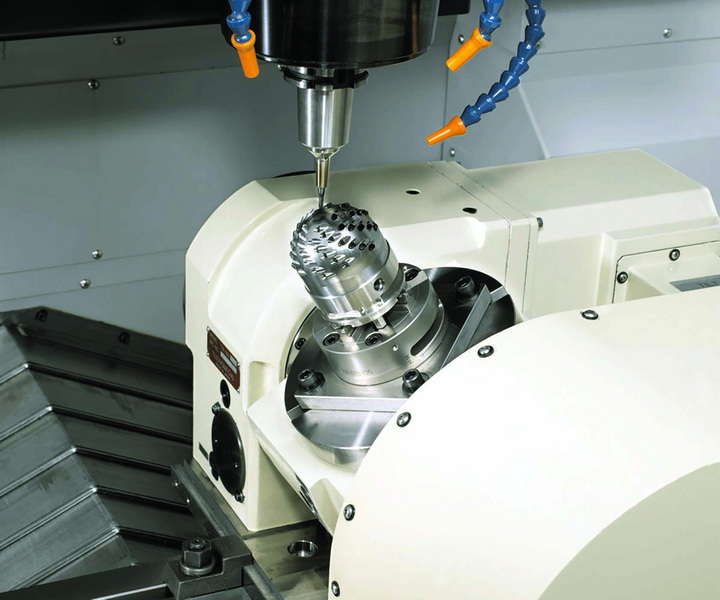
Japanese manufacturers leverage 5-axis machining across various industries requiring extreme precision and complex geometries:
- Aerospace: Machining turbine blades, structural components, and complex aerospace parts with tight tolerances. The ability to machine free-form surfaces and internal passages in a single setup is critical for aerospace manufacturers aiming to reduce weight and improve performance.
- Automotive: Manufacturing engine blocks, molds, and turbocharger parts with intricate details and smooth finishes. 5-axis machining enables the production of lightweight, high-strength components that meet stringent emission and safety standards.
- Medical Devices: Producing implants, surgical instruments, and prosthetics requiring complex shapes and biocompatible materials. The precision and surface finish achievable with 5-axis machining are essential for patient safety and comfort.
- Die & Mold Making: Creating molds and dies with complex contours and fine surface finishes. 5-axis machining reduces the number of setups, improving accuracy and reducing lead times for mold production.
- Electronics: Precision machining of components for electronic devices and semiconductor manufacturing equipment. The ability to machine small, intricate parts with tight tolerances supports the miniaturization trend in electronics.
Japanese 5-axis machining manufacturers are at the forefront of integrating automation and digital manufacturing technologies to enhance productivity and quality. Automation solutions such as robotic part loading/unloading, automated pallet changers, and tool changers reduce manual intervention and increase machine utilization. These features are especially valuable in high-volume production environments where consistency and speed are paramount.
Furthermore, the adoption of Industry 4.0 principles allows manufacturers to collect and analyze machine data in real-time. This data-driven approach enables predictive maintenance, reducing unexpected downtime, and optimizing production schedules. Digital twins and simulation software are also used extensively to validate machining strategies before actual production, minimizing errors and material waste.
The advanced capabilities of Japanese 5-axis machining centers contribute to more sustainable manufacturing practices. By reducing the number of setups and machining cycles, energy consumption is lowered. Precision machining also minimizes material waste, which is particularly important when working with expensive or rare materials such as titanium and exotic alloys.
Economically, the efficiency gains from 5-axis machining translate into faster time-to-market and lower overall production costs. Manufacturers can respond quickly to changing market demands and customize products without significant cost penalties. This flexibility is crucial for industries like medical devices and aerospace, where innovation and customization drive competitive advantage.
- Technological Leadership: Japan's manufacturers lead in CNC control systems, machine rigidity, and automation integration.
- Quality and Precision: Consistent delivery of parts meeting tight tolerances and complex geometries.
- Innovation: Continuous R&D investment drives improvements in machining speed, surface finish, and multi-tasking capabilities.
- Customer Support: Extensive global networks provide comprehensive after-sales service and technical support.
- Sustainability: Advanced machines reduce energy consumption and material waste, contributing to greener manufacturing.
Japan's top 5-axis machining manufacturers and suppliers represent the pinnacle of precision engineering and manufacturing excellence. Companies like Yamazaki Mazak, DMG MORI, Okuma, Makino, and DAISHIN SEIKI have set global standards by combining advanced CNC technology, automation, and deep industry expertise. Their 5-axis machining solutions empower industries from aerospace to medical devices to produce complex, high-quality parts with efficiency and reliability. For brands and manufacturers seeking superior OEM services, Japanese 5-axis machining providers offer unmatched capabilities that drive innovation and competitive advantage in today's demanding markets.
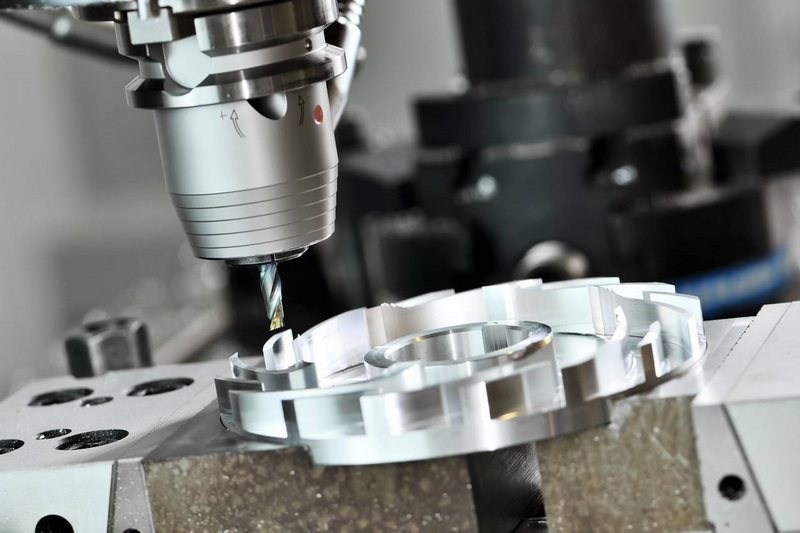
Industries such as aerospace, automotive, medical devices, die & mold, and electronics benefit greatly due to the need for complex geometries, tight tolerances, and high precision.
They utilize advanced CNC controls, rigid machine structures, thermal stability technologies, and comprehensive quality management systems to maintain consistent precision and surface finish.
Yes, many manufacturers like DAISHIN SEIKI specialize in both prototyping and small to medium batch production, supported by automation and flexible machining centers.
Innovations include integrated multi-tasking machines combining milling and turning, digital automation platforms, advanced CAM software integration, and energy-efficient machine designs.
Typically, you provide detailed part drawings (2D/3D CAD files) and specifications to the manufacturer. They will offer a quotation, followed by prototyping and production phases with dedicated project management and support.

