


Content Menu
● About Shangchen CNC Machining Services
● How CNC Machining Works: End-to-End Workflow
>> Design and CAD Model Creation
>> CAM Programming and G-Code Generation
>> Machine Setup and Workholding
>> Executing CNC Machining Operations
>> Inspection, Finishing, and Quality Control
● Core CNC Machining Processes
>> CNC Milling
>> CNC Turning (Lathe Machining)
>> Drilling, Boring, and Tapping
>> Grinding and High-Precision Finishing
● Types of CNC Machines and Axes
● Materials Used in CNC Machining
● Advantages of CNC Machining for OEMs
>> Precision and Repeatability
>> Speed, Flexibility, and Low Tooling Cost
>> Complex Geometries and Multi-Axis Capability
● Typical Applications of CNC Machining
● CNC Machining and Other Manufacturing Processes
● How Shangchen Serves Overseas OEM Customers
● FAQs
>> 1. What is CNC Machining and why is it important?
>> 2. Which materials can Shangchen handle with CNC Machining?
>> 3. When should OEMs choose CNC Machining instead of 3D printing?
>> 4. How does Shangchen ensure CNC Machining quality for overseas customers?
>> 5. What information is needed to request a CNC Machining quote from Shangchen?
Shangchen (sc-rapidmanufacturing.com) is a China-based OEM factory specializing in CNC Machining, rapid prototyping, CNC milling, CNC turning, sheet metal fabrication, 3D printing, vacuum casting, and injection molding for overseas brands, wholesalers, and manufacturers. CNC Machining uses computer-controlled machine tools to remove material from metal or plastic stock with high precision, making it ideal for both functional prototypes and precision batch production.[1][10][11][12]
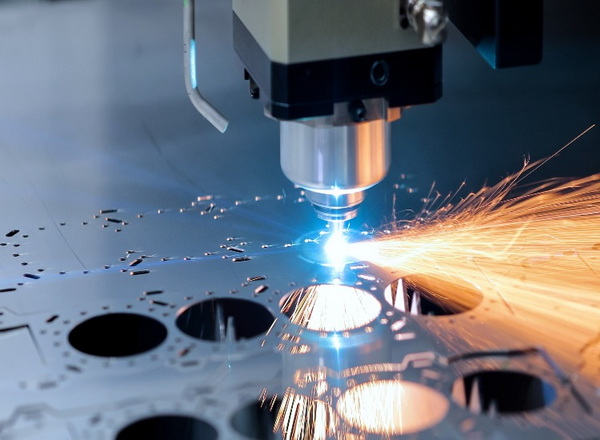
Shangchen provides end-to-end CNC Machining services from design review and DFM optimization through rapid prototyping and precision batch manufacturing, helping overseas OEM customers shorten development cycles and reduce risk. The factory operates advanced 3-axis, 4-axis, and 5-axis machining centers, CNC lathes, and related equipment to deliver tight-tolerance, complex components that meet international quality standards.[4][10][11]
To support different industries and project stages, Shangchen offers CNC milling, CNC lathe turning, 5-axis machining, sheet metal fabrication, 3D printing, vacuum casting, and injection molding, which can be combined in a single project to balance cost, speed, and performance. Overseas customers benefit from OEM/ODM capabilities, engineering support, and rigorous quality control tailored for demanding sectors such as automotive, robotics, industrial equipment, consumer electronics, and medical devices.[11][13][14]
CNC Machining (Computer Numerical Control machining) is a subtractive manufacturing process in which pre-programmed computer software directs the motion of cutting tools and machine axes to shape a part from solid material. Instead of relying on manual handwheels and gauges, CNC Machining automates movement, speed, and tool changes using digital instructions, resulting in higher precision, repeatability, and efficiency.[2][3][7]
CNC Machining covers a range of operations—milling, turning, drilling, boring, and grinding—performed on metals, plastics, and other engineering materials. Because toolpaths are generated from 3D CAD models, CNC Machining can achieve complex 3D geometries, tight-tolerance critical features, and high-quality surface finishes suitable for both prototypes and full production.[3][15][1]
CNC Machining follows a structured digital workflow that transforms a design into finished hardware, with each step influencing cost, accuracy, and lead time. Understanding this workflow helps OEM customers collaborate more effectively with partners like Shangchen on CNC Machining projects.[10][1][4][11]
Every CNC Machining project starts with a 2D or 3D CAD model that defines geometry, dimensions, tolerances, and functional requirements. Engineers use CAD tools such as SolidWorks, AutoCAD, or Fusion 360 to model parts, specify key surfaces, and generate drawings that guide subsequent CNC Machining operations.[8][1][4]
Design-for-manufacturing (DFM) review is essential before CNC Machining begins, especially for thin walls, deep pockets, or narrow features that are challenging to cut. By adjusting radii, wall thickness, and tolerances at this stage, OEMs can significantly reduce CNC Machining cost and risk while maintaining performance.[9][14][4]
Once the CAD model is approved, it is imported into CAM (Computer-Aided Manufacturing) software, which converts geometry into CNC Machining toolpaths. CAM systems choose cutting tools, set spindle speeds, feed rates, stepovers, and depths of cut, then generate machine-specific code that controls motion and auxiliary functions.[5][3][4]
CNC Machining programs typically use G-code to describe movements (linear and arc paths) and M-code to manage machine functions such as spindle on/off and coolant control. Modern CAM platforms simulate CNC Machining virtually to check collisions, verify material removal, and optimize cycle times before any material is actually cut.[7][4][8]
In the setup stage, technicians select the appropriate CNC Machining equipment—such as a 3-axis mill, 5-axis machining center, or CNC lathe—based on geometry and tolerance requirements. Workpieces are secured using vises, modular fixtures, custom jigs, or pneumatic/hydraulic clamps that prevent movement during CNC Machining.[3][4][7]
Tool setup involves installing cutters in holders, measuring tool length and diameter with presetters or probes, and entering offset data into the CNC controller. Operators then establish work coordinate systems by touching off reference surfaces or using probing cycles, which ensures the CNC Machining program aligns exactly with the physical part position.[4][7][3]
With setup complete, the CNC machine executes the program, controlling spindle speed, feed rates, and multi-axis movements according to the G-code instructions. Servo motors and closed-loop feedback systems guide axes with very fine step resolution, enabling CNC Machining to achieve high accuracy and consistent surface finishes.[8][3][4]
CNC Machining usually proceeds in stages: roughing removes bulk material quickly, semi-finishing approaches final dimensions, and finishing passes deliver final dimensions and surface quality. Coolant systems, chip evacuation strategies, and tool monitoring help keep temperatures under control and extend tool life during demanding CNC Machining cycles.[5][3][4]
After machining, parts undergo inspection to verify that critical dimensions, tolerances, and surface requirements are within specification. Depending on accuracy needs, inspections may use gauges, micrometers, height gauges, optical measurement, or coordinate measuring machines (CMMs) to validate CNC Machining results.[12][4][8]
Parts may also receive post-processing such as deburring, polishing, anodizing, plating, painting, or laser marking to meet functional and cosmetic requirements. For overseas OEMs, Shangchen combines CNC Machining, finishing, and quality documentation to ensure each shipment matches drawing and regulatory expectations.[15][10][11][12]
Different CNC Machining processes are selected based on whether parts are prismatic, cylindrical, or highly complex. Often, several processes are combined in one routing to achieve all required features efficiently.[16][4][5]
CNC milling is a CNC Machining process where rotating multi-point cutting tools move along multiple axes while the workpiece remains fixed, producing faces, pockets, slots, contours, and 3D surfaces. Vertical and horizontal machining centers can operate in 3-axis, 4-axis, or 5-axis configurations, allowing access to more surfaces in fewer setups.[12][16][4][5]
CNC milling is ideal for housings, brackets, structural components, and mold inserts that require accurate flat surfaces and detailed features. Shangchen uses CNC milling extensively for aluminum and steel parts where CNC Machining must achieve tight tolerances, consistent cosmetic finishes, and reliable assembly fit.[10][11][15][16]
CNC turning is a CNC Machining method where the workpiece rotates while a stationary cutting tool moves linearly to generate cylindrical shapes such as shafts, pins, and bushings. Turning operations include facing, OD/ID turning, grooving, drilling, boring, and threading, often completed in a single setup on a CNC lathe.[17][16][4]
Modern turning centers may feature live tooling and sub-spindles, enabling combined turning and milling operations and reducing the number of CNC Machining setups. Shangchen applies CNC turning to produce high-precision rotational parts for connectors, fasteners, drive shafts, and other components supplied to global OEMs.[18][11][4][5]
Drilling is a CNC Machining process for creating round holes using rotating multi-point tools positioned precisely by the machine axes. For deep or critical holes, peck drilling and specialized cycles are used to control chip evacuation and maintain straightness.[19][7][4]
Boring enlarges and trues existing holes to achieve tighter tolerances and better surface finishes, often as a finishing step after drilling in CNC Machining. Tapping and thread milling create internal threads, allowing CNC Machining to produce complete, assembly-ready components without secondary manual operations.[15][4][5]
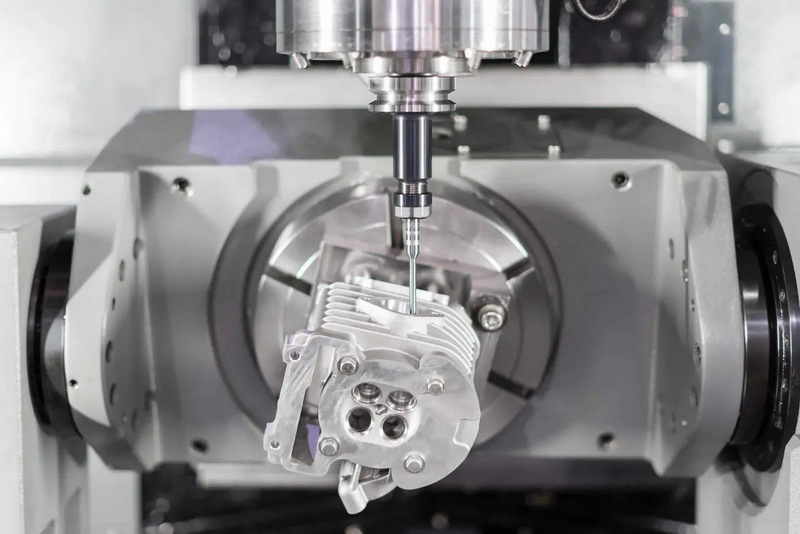
Grinding complements CNC Machining when extremely tight tolerances and fine surface finishes are required on hardened materials. CNC-controlled grinding machines use abrasive wheels and precise axis control to achieve micrometer-level accuracy on critical surfaces.[4][8][15]
In many OEM projects, CNC Machining establishes overall geometry, while selective grinding and surface treatments finalize critical areas such as sealing faces, bearing seats, or optical surfaces. Shangchen coordinates these steps so that CNC Machining parts meet both dimensional and cosmetic specifications in a single managed workflow.[11][10][12][4]
CNC Machining configurations differ in the number of controllable axes and how tools and workpieces move. Choosing the right platform affects achievable geometry, precision, and cost.[3][4]
- 3-axis mills use linear X, Y, and Z axes and are widely used for general CNC Machining of flat surfaces and simple 3D features.[7][4]
- 4-axis mills add a rotary axis, enabling more efficient machining of cylindrical or multi-sided parts in one setup.[3][4]
- 5-axis mills add two rotary axes, allowing tool orientation to tilt and rotate, which is essential for complex aerospace, medical, and high-end industrial parts.[4][3]
Advanced multi-axis CNC Machining centers can integrate milling and turning functions, reducing handling and improving accuracy. Shangchen uses appropriate combinations of 3-axis, 4-axis, 5-axis, and turning platforms to balance cost and flexibility for different OEM projects.[18][8][11][4]
CNC Machining supports a broad portfolio of materials, giving engineers freedom to match mechanical, thermal, and aesthetic requirements. Material selection influences machinability, cost, tool wear, and achievable surface finish in CNC Machining.[14][12][3][4]
Typical CNC Machining metals include aluminum alloys for lightweight structures, stainless steels for corrosion resistance, carbon and alloy steels for strength, and brass or copper for electrical and fluid applications. Engineering plastics such as ABS, POM, PEEK, PC, and nylon are also frequently used in CNC Machining for lightweight, insulating, or wear-resistant parts.[14][12][3]
Shangchen machines both metals and plastics, allowing overseas customers to prototype and produce parts in materials that closely resemble their final production choices. This capability makes CNC Machining particularly attractive for functional prototypes, engineering validation units, and bridge production before committing to dedicated tooling.[9][10][11][14]
CNC Machining delivers several advantages that make it a foundational process for modern manufacturing supply chains. When combined with an experienced partner like Shangchen, these strengths translate directly to faster development and more reliable products for overseas OEMs.[10][11][14][3]
CNC Machining uses closed-loop control, accurate tooling, and stable fixturing to consistently achieve tight dimensional tolerances. This precision is essential for components that must assemble smoothly, maintain sealing, or support high loads in industries such as aerospace, automotive, and medical devices.[8][14][3][4]
Because CNC Machining programs can be stored, reused, and refined, large batches of parts can be produced with minimal variation between pieces. Shangchen leverages this repeatability to support ongoing OEM production with stable quality across multiple batches and revisions.[7][11][10][3]
Once a model and program are prepared, CNC Machining can produce parts quickly without the need for expensive dedicated molds or dies. This makes CNC Machining ideal for prototypes, custom parts, spare components, and low- to medium-volume production.[9][14][3]
CNC Machining also offers flexibility to change designs between runs simply by updating the CAD/CAM data, with no need to rework tooling. Shangchen takes advantage of this flexibility to help OEMs iterate designs rapidly and adapt to market feedback with minimal delay.[1][5][11][10]
Multi-axis CNC Machining, especially 5-axis, allows cutting tools to approach the part from different angles, enabling undercuts, compound curves, and intricate 3D shapes. This capability reduces the number of setups, shortens cycle times, and expands the design space for engineers.[8][3][4]
Shangchen applies multi-axis CNC Machining to demanding components such as impellers, medical implants, complex enclosures, and precision brackets where geometry is critical. For many OEMs, this unlocks designs that would be costly or impossible with purely manual methods.[13][5][11][3]
CNC Machining is used wherever accurate, reliable, and customizable components are required, from early prototypes to long-term production. Because of its versatility, it plays a central role in many industries' product development processes.[20][14][9][3]
Common CNC Machining applications include product housings, structural brackets, gears and shafts, jigs and fixtures, test rigs, and custom tooling. CNC Machining is also widely used for high-performance components in robotics, automation systems, automotive powertrain parts, aerospace structures, and medical instruments.[21][20][14][3]
Shangchen supports customers in aviation, automotive, robotics, industrial automation, medical devices, new energy, and consumer products through its integrated CNC Machining and rapid manufacturing services. Overseas brands often rely on Shangchen's CNC Machining capability to handle both pilot runs and continuous supply for global markets.[13][11][10]
CNC Machining sits alongside 3D printing, sheet metal fabrication, and molding as part of a complete manufacturing toolkit. Choosing the right process depends on part geometry, performance requirements, and expected volume.[22][14][9]
For very early concept models with complex internal structures but modest mechanical demands, 3D printing may be more economical than CNC Machining. When volumes become higher and parts are suitable for plastics, injection molding can outperform CNC Machining on per-unit cost, but usually requires significant upfront tooling investment.[22][13][14]
Many OEMs therefore rely on CNC Machining for functional prototypes, design validation, and bridge production while mold tooling is being designed and built. Shangchen coordinates CNC Machining, 3D printing, sheet metal, and molding to give customers an optimized path from idea to mass production.[11][13][14][9]
For international brands and wholesalers, working with a capable CNC Machining supplier in China combines cost advantages with broad technical capability. Shangchen positions CNC Machining at the center of its value proposition for overseas OEMs.[13][10][11]
Shangchen offers engineering consultation, design feedback, and quick quotations based on customer CAD and drawing packages, helping refine parts for efficient CNC Machining and downstream processes. The factory's mix of CNC Machining, sheet metal fabrication, 3D printing, vacuum casting, and molding allows customers to consolidate multiple needs with one partner.[10][11][13]
To meet international standards, Shangchen follows strict process controls, uses appropriate inspection equipment, and documents CNC Machining quality results before shipment. With logistics experience and export-oriented packaging practices, Shangchen ensures CNC Machining parts arrive safely and ready for assembly at overseas facilities.[23][12][10]
CNC Machining is a precise and flexible subtractive manufacturing process that transforms digital designs into accurate physical parts by controlling cutting tools with computer numerical control. From CAD modeling and CAM programming to multi-axis cutting and careful inspection, every step of CNC Machining contributes to consistent quality and fast turnaround for demanding applications. For overseas OEM brands, wholesalers, and manufacturers, Shangchen (sc-rapidmanufacturing.com) provides integrated CNC Machining services—covering milling, turning, drilling, finishing, and complementary processes—to support rapid prototyping, bridge production, and ongoing supply with reliable quality and competitive cost.[2][1][11][3][4][10]

CNC Machining is a computer-controlled manufacturing process that removes material from a solid workpiece using programmed toolpaths to achieve precise shapes and dimensions. It is important because it offers high accuracy, repeatability, and flexibility, enabling OEMs to produce complex parts quickly without expensive dedicated tooling.[2][9][3]
Shangchen can perform CNC Machining on metals such as aluminum, stainless steel, carbon steels, brass, and copper, as well as many engineering plastics. This broad material capability allows overseas customers to prototype and produce components in materials that closely match final application requirements using CNC Machining.[12][14][11][10]
OEMs typically choose CNC Machining when parts require tight tolerances, superior surface finishes, or materials that are difficult or costly to print. For functional prototypes, structural components, and low- to medium-volume production, CNC Machining usually offers better mechanical performance and dimensional control than most additive processes.[14][9][3]
Shangchen controls CNC Machining quality through robust process planning, appropriate machine selection, and standardized setup and inspection procedures. Dimensional checks, surface evaluations, and, where required, advanced metrology are combined with engineering review so that parts meet drawings and OEM standards before shipment.[11][12][10]
To obtain a CNC Machining quotation from Shangchen, customers usually provide 3D CAD models, 2D drawings with critical dimensions and tolerances, material and surface finish requirements, and target quantities and delivery timelines. With this information, Shangchen can propose suitable CNC Machining strategies and provide accurate pricing and lead-time estimates for prototypes or production runs.[23][10][11]
[1](https://www.3erp.com/manufacturing-technology/cnc-machining/)
[2](https://astromachineworks.com/what-is-cnc-machining/)
[3](https://www.xometry.com/resources/machining/what-is-cnc-machining/)
[4](https://yijinsolution.com/processes/)
[5](https://avantiengineering.com/cnc-machining-types-processes-costs/)
[6](https://www.youtube.com/watch?v=lEyNWtM6MW4)
[7](https://geomiq.com/cnc-machining-guide/)
[8](https://academy.titansofcnc.com/files/Fundamentals_of_CNC_Machining.pdf)
[9](https://www.protolabs.com/resources/guides-and-trend-reports/cnc-machining-for-prototypes-and-low-volume-production-parts/)
[10](https://www.sc-rapidmanufacturing.com)
[11](https://www.sc-rapidmanufacturing.com/cnc-machining.html)
[12](https://www.rapidmfgco.com/services/cnc-machining)
[13](https://tirapid.com/rapid-prototyping-services-china/)
[14](https://www.makerverse.com/resources/cnc-machining-guides/the-guide-to-cnc-machining-for-prototyping/)
[15](https://www.ycmalliance.com/everything-you-need-to-know-about-cnc-machining/)
[16](https://trimantec.com/blogs/t/machining-processes-overview)
[17](https://jbcmachine.com/what-is-the-difference-between-turning-drilling-and-milling-operations/)
[18](https://www.sc-rapidmanufacturing.com/products/CNC-Services.html)
[19](https://www.trade-tech.com/an-intro-to-the-cnc-machining-process/)
[20](https://www.shopsabre.com/5-applications-of-cnc-machines/)
[21](https://uptivemfg.com/cnc-prototype-machining/)
[22](https://asia.arrk.com/how-cnc-machining-enhances-prototyping/)
[23](https://www.rapiddirect.com/services/cnc-machining/)

