
Views: 222 Author: Amanda Publish Time: 2025-08-12 Origin: Site


Content Menu
● Importance of 5-Axis Machining in Electronics Manufacturing
● How 5-Axis Machining Works in Electronics Miniaturization
● Applications of 5-Axis Machining in Electronics
>> Semiconductor Equipment Parts
>> Aerospace and Defense Electronics
● Benefits of 5-Axis Machining in Electronics Manufacturing
● Challenges and Considerations
● Frequently Asked Questions (FAQ)
>> 1. What is the main advantage of 5-axis machining over 3-axis machining?
>> 2. How does 5-axis machining contribute to miniaturization in electronics?
>> 3. Is 5-axis machining suitable for all electronic materials?
>> 4. Does 5-axis machining reduce manufacturing costs?
>> 5. What industries benefit most from 5-axis machining in electronics?
In the rapidly evolving electronics industry, the demand for smaller, faster, and more complex components is greater than ever before. Achieving the miniaturization required for modern devices while maintaining the highest accuracy poses significant manufacturing challenges. This is where 5-axis machining becomes a game-changer. By enabling precise and flexible cutting tool control, 5-axis machining drives the creation of intricate and compact electronic parts with unparalleled precision and efficiency.

5-axis machining is an advanced form of CNC (computer numerical control) machining that allows cutting tools to move along five different axes simultaneously—typically three linear axes (X, Y, Z) plus two rotational axes (usually A and B or B and C). This capability stands in contrast to traditional 3-axis machining, which moves the tool in only three linear directions.
The extra axes facilitate tool orientation from virtually any angle toward the workpiece, enabling the machining of complex, contoured surfaces and intricate geometries in a single setup. This technology dramatically enhances manufacturing flexibility, especially for delicate and highly detailed electronic components.
Modern electronic devices—such as smartphones, laptops, wearables, and medical devices—rely on compact components with extremely tight tolerances. 5-axis machining enables manufacturers to produce smaller parts with complex geometries that are otherwise impossible or cost-prohibitive with 3-axis machines.
- Compact, Multi-Faceted Designs: The ability to access complex angles allows for machining multi-faced parts without numerous repositionings.
- Undercuts and Deep Cavities: 5-axis machines can handle undercuts and deep cavities required for integrated circuits and connectors.
- Complex Features in Limited Space: With the capability to tilt and rotate tools, intricate microfeatures such as micro-channels, slots, and grooves can be machined effectively, enabling the miniaturization of assemblies without compromising mechanical or electrical performance.
Precision is critical in electronics, where a few microns of deviation can cause functional failures or incompatibility in assemblies. 5-axis machining achieves superior accuracy by:
- Reducing setups: A single fixture setup replaces multiple setups, minimizing alignment errors.
- Continuous tool contact: Tools maintain optimal orientation and engagement during cuts, resulting in consistent surface finishes.
- Enhanced control: Advanced CNC systems compensate for tool deflection and positioning errors.
- Elimination of Secondary Operations: Because 5-axis machining allows precise multi-surface machining in one go, there is less need for additional finishing or manual correction, reducing variability and improving consistency.
With 5-axis machining, the production timeline of complex electronic parts is significantly shortened. Eliminating multiple setups reduces fixture preparation, alignment time, and tool changes.
- Faster Cycle Times: Increased throughput through optimized material removal strategies.
- Consistent Quality: Reduced scrap and rework due to fewer handling errors and superior finish.
- Integrated Process Capability: Combining milling, drilling, and contouring operations in one setup streamlines workflow and saves labor.
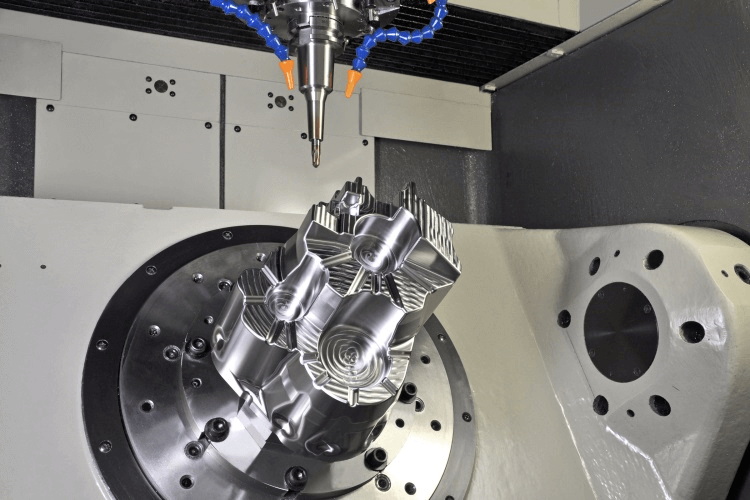
In traditional 3-axis machining, manufacturing a complex multi-faced electronics part might require several separate setups. Each time the piece is repositioned, accuracy is jeopardized by slight misalignments. 5-axis machines orient the tool to machine multiple faces without changing the workpiece position, achieving all necessary features in a single setup.
This single-setup approach is essential for ensuring:
- Geometric accuracy.
- Repeatability in batch production.
- Minimization of manual handling, preserving delicate microfeatures.
The 5-axis CNC control software calculates optimized tool paths that maintain the cutting tool at the ideal engagement angle with the workpiece surface. This dynamic orientation:
- Maintains constant chip load.
- Minimizes tool wear.
- Reduces heat generation.
- Delivers smooth surface finishes without secondary processing.
Advanced CAM (Computer-Aided Manufacturing) software leverages simulation and collision detection to refine tool moves, ensuring that even the most complex geometries are machined efficiently and safely.
Manufacturing microelectronic components demands tight dimensional tolerances. 5-axis machining reduces cumulative positioning errors by:
- Keeping the part fixed in one coordinate system throughout machining.
- Using closed-loop feedback controls for precise positioning of linear and rotary axes.
- Applying motion compensation strategies to correct geometric errors.
- Utilizing high-precision rotary tables and linear guides to ensure stable and smooth motion, essential for micro-level accuracy.
Detail-rich circuit board connectors and housings require intricate machining. 5-axis capabilities enable the creation of features such as fine slots, precise holes, and contoured shapes with minimal tool changes. This ensures reliability and interoperability in complex electronic assemblies.
Miniature parts in medical monitoring and implantable devices often have complex shapes demanding micron-level accuracy. 5-axis machining supports the manufacturing of biocompatible materials with exceptional surface finishes, contributing to medical device efficacy and patient safety.
Smartphones and wearable devices benefit from 5-axis machining for cases, frames, and internal components that combine strength with lightweight and complex geometry. This allows designers more freedom to innovate on form factors without manufacturing constraints.
Critical parts in semiconductor manufacturing equipment require precise geometries, often with internal channels and complex external surfaces. 5-axis machining meets these demanding specifications efficiently, ensuring high uptime and performance of semiconductor tools.
The aerospace and defense sectors rely on miniature electronic components with stringent tolerance and reliability requirements. 5-axis machining produces intricate parts such as sensor housings and avionics connectors that must endure extreme operational environments.
The full benefits of 5-axis machining extend beyond the obvious advantages in design freedom and accuracy:
- Design Freedom: Complex shapes, undercuts, and tight radii that are challenging or impossible with 3-axis machines become feasible, allowing engineers to innovate without compromise.
- Higher Precision: A single setup reduces alignment errors and tool engagement is more consistent, dramatically improving dimensional accuracy.
- Improved Surface Quality: Consistent tool orientation yields smoother surfaces, reducing or eliminating secondary finishing and polishing steps.
- Reduced Production Time: Fewer setups and optimized tool paths translate to shorter machining cycles and faster lead times.
- Lower Costs: Less manual labor, fewer scrapped components, and extended tool life combine to decrease overall manufacturing costs.
- Longer Tool Life: Tools operate at optimal cutting angles reducing stress and wear, which cuts down tooling expenses and downtime.
- Material Versatility: Ability to machine a wide range of materials used in electronics, including aluminum alloys, stainless steels, exotic metals, and plastics.
- Scalability: Suitable for small prototype runs as well as volume batch production, providing flexibility for OEMs and contract manufacturers.
While 5-axis machining offers undeniable advantages, manufacturers must consider:
- Higher Initial Investment: 5-axis CNC machines and tooling require more capital compared to 3-axis equipment.
- Programming Complexity: Skilled operators and advanced CAM software are essential to fully exploit the machine's capabilities and avoid costly programming errors.
- Maintenance: Complex mechanical and electronic systems demand rigorous maintenance schedules to sustain high precision.
- Material Constraints: Some delicate electronic materials are sensitive to heat and require optimized tool coatings, cutting speeds, and coolant strategies.
- Training Requirements: Continued operator training is necessary to maximize productivity and ensure safety.
- Workholding Solutions: Custom fixtures and precise workholding techniques are often needed to secure miniature, delicate parts without deformation.
5-axis machining has revolutionized electronics manufacturing by enabling the production of increasingly miniaturized and accurate components. Its ability to machine complex geometries in a single setup delivers unmatched precision, efficiency, and cost savings. As electronic devices continue to shrink and demand higher performance, the use of 5-axis CNC machining is indispensable for OEMs and contract manufacturers aiming to deliver cutting-edge products with reliable quality. Investing in 5-axis capabilities not only supports current industry needs but also future-proofs production for emerging microelectronics technologies.

5-axis machining allows the cutting tool to move and orient in five different axes simultaneously, enabling access to complex geometries and multiple faces in a single setup. This reduces production time, improves precision, and maintains better surface finishes compared to 3-axis machining.
By allowing intricate and precise machining of small and complex parts from multiple angles without repositioning, 5-axis machining supports the fabrication of miniature electronic components with the tight tolerances required for modern devices.
While 5-axis machining is versatile, some delicate or heat-sensitive materials used in electronics may require specially coated tools, optimized cutting parameters, or coolant methods to prevent damage during machining.
Yes, by reducing the number of setups, improving tool life, and minimizing rework, 5-axis machining decreases labor, tooling, and scrap costs, resulting in overall lower production expenses.
Industries like consumer electronics, medical devices, semiconductor manufacturing, and aerospace electronics benefit significantly due to their demand for complex, precise, and miniature components.
[1] https://www.ptsmake.com/5-axis-cnc-machining-slash-costs-boost-precision-full-guidewhat-is-5-axis-cnc-machining/
[2] https://www.jstage.jst.go.jp/article/ijat/13/5/13_583/_pdf
[3] https://phillipscorp.com/india/5-axis-machining-in-electronics-manufacturing/
[4] https://www.heidenhain.com/fileadmin/pdf/en/01_Products/Technische_Dokumentation/TI_Influence_of_Position_Measurement_on_Accuracy_5-Axis_Machining_ID895283_en.pdf
[5] https://link.springer.com/article/10.1007/s00170-023-10864-w
[6] https://sensors.myu-group.co.jp/sm_pdf/SM2170.pdf
[7] https://www.sciencedirect.com/science/article/abs/pii/S0890695507002659
[8] https://www.nature.com/articles/s41598-025-10937-8

